Ask a managed service provider which services clients request more and more often, and connectivity will be near the top of the list. Clients open new sites, deploy connected devices and send teams abroad, and they would like one partner who keeps all of it online. For MSPs, this is a natural extension of the role they already play: taking care of technology so the client can focus on running the business.
This article explains how MSP connectivity works in practice. It covers the building blocks of a connectivity service, how fixed wireless access and SIM management fit in, how to design reliable networks for branch offices, when a local SIM contract is the best fit and what to look for in a connectivity partner. Each topic links to a more detailed blog, so you can go deeper wherever it matters for your clients.
Table of contents
- What is a managed service provider
- Why connectivity fits the MSP model
- The building blocks of a connectivity service
- Fixed wireless access: fast connectivity for any site
- SIM management at scale
- Designing branch connectivity
- Roaming SIM or local SIM contract
- Designing for uptime and SD-WAN performance
- Security for business critical connectivity
- Business models: reselling and white label
- Connectivity needs by sector
- What is next: 5G and SGP.32
- Choosing a connectivity partner
- Getting started with managed connectivity
- Frequently asked questions
What is a managed service provider
A managed service provider (MSP) takes ongoing responsibility for part of a client’s IT environment and delivers it as a service, usually for a fixed monthly fee and under a service level agreement. That can include network management, cloud infrastructure, security, device management and helpdesk support.
In connectivity, MSPs come in several forms. Regional ISPs and wireless ISPs extend their fixed line portfolio with mobile and wireless services. SD-WAN and managed network specialists design and run networks for multi site organisations. IoT solution providers deliver devices with connectivity included, and system integrators support retail, logistics and industrial clients with everything from routers to monitoring.
Whatever the starting point, the work is similar. The MSP designs the right mix of connections for each location, sources the SIMs, routers and contracts, monitors performance and resolves issues when they arise. The client receives one service with one point of contact, which is exactly what makes the model attractive.
Why connectivity fits the MSP model
Connectivity grows with the client. When a client opens a new branch, launches an IoT product or expands into a new country, the need for connectivity grows with it. For an MSP, every step in the client’s growth adds recurring revenue and strengthens the relationship.
Several developments make this a good moment to build a connectivity offer. 5G fixed wireless access has matured into a dependable option for business sites. IoT fleets are growing in almost every sector, and clients value a partner who can manage thousands of SIMs across countries from one place. And the eSIM standard SGP.32 is making it easier to provision and switch connectivity remotely, which suits MSPs that manage devices on behalf of many clients.
The building blocks of a connectivity service
A connectivity service consists of a few layers, and it helps to look at each one separately when designing a solution for a client.
Access is how data reaches a site. The most common options are fixed lines such as fibre, fixed wireless access over 4G and 5G, and dedicated internet access for locations that need guaranteed bandwidth.
SIMs and contracts determine which mobile networks a device can use and at what cost. A multi network roaming SIM can connect to several carriers in each country. A steered roaming SIM follows the preferred partner network of its home operator, while a non steered roaming SIM can select the strongest available network, which is valuable for backup links and mobile use.
A local SIM contract connects directly to a national carrier and is priced for high data volumes. eSIM adds the option to download and change carrier profiles remotely.
Hardware brings it all together at the site: a cellular router, sometimes with an external antenna, and often with multiple SIM slots for redundancy.
Management is the software layer where the MSP activates SIMs, monitors usage, sets alerts and bills clients.
Security covers options such as private APN, fixed IP addresses and VPN, which keep client traffic separate and protected.
Very few carriers cover all of these layers in every country. That is why many MSPs work with a connectivity broker: a partner with agreements across many carriers and a wide portfolio of SIM types, contracts and hardware, managed through one platform.
TNF Solutions works this way, with access to more than 750 networks in over 200 countries and typically three to five carriers per country. This gives MSPs the freedom to choose the best fit for each client location, from a roaming SIM for a delivery van to a high volume local SIM for a busy retail site.
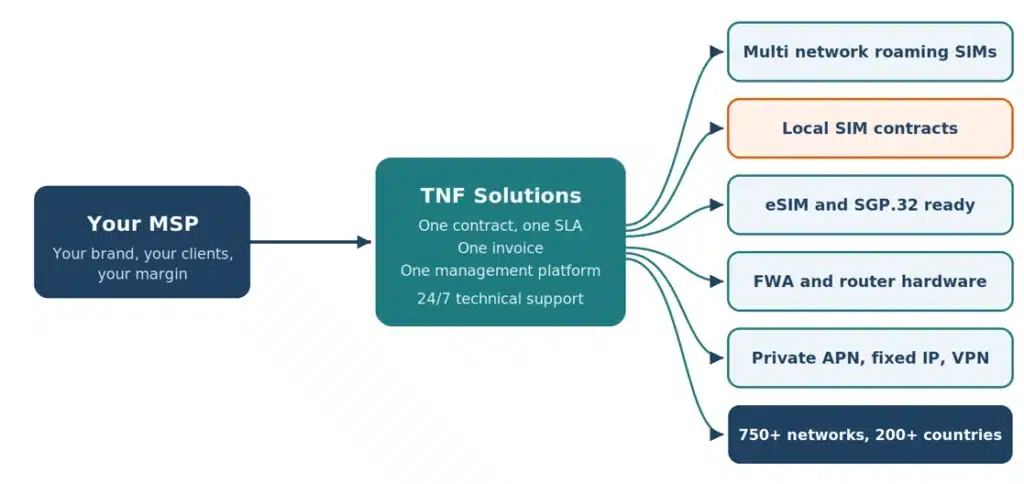
With a connectivity broker, one partnership gives an MSP access to every building block its clients need.
The table below shows how the two sourcing approaches compare in daily operations.
| Area | Sourcing directly per carrier | Sourcing through a connectivity broker |
|---|---|---|
| Contracts | One contract per country or carrier | One contract covering many countries |
| Solution choice | The portfolio of each individual carrier | Roaming SIMs, local SIM contracts, eSIM, FWA and security combined |
| Management | A separate portal per carrier | One platform for all SIMs and carriers |
| Billing | Several invoices, currencies and billing cycles | One consolidated invoice |
| Support | A support desk per carrier | One support team for every network |
| Adding a country | A new negotiation, often taking weeks | Usually a matter of days |
Fixed wireless access: fast connectivity for any site
Fixed wireless access (FWA) delivers business broadband to a fixed location over 4G or 5G. A cellular router with a SIM connects to the nearest mobile mast, and an external antenna can improve reception where the signal indoors is weak.
The router then distributes the connection over the local network, just like any broadband line. Since no cable needs to be laid, a site can go live as soon as the router is installed.
MSPs use FWA in three main ways. As a primary connection, it serves sites where fibre is unavailable or would take months to install. As a backup, it keeps a site online when the fixed line has an interruption. And as temporary connectivity, it suits pop up stores, construction sites and events.
Our blog what is fixed wireless access (FWA)? A guide for businesses explains the technology and these use cases in more detail.
Clients often ask how FWA compares with fibre. Fibre offers very high and consistent capacity wherever it is available, while FWA stands out for deployment speed and flexibility. Many well designed networks use both, with fibre as the primary line and FWA on a different carrier as the backup.
The article fixed wireless access vs fiber: which is right for business connectivity? walks through speed, cost, installation time and resilience so you can advise clients per site.
The router has a large influence on the result. Important points to consider are the modem category and 5G support, the number of SIM slots for dual carrier setups, compatibility with the client’s SD-WAN and firewall, and options for remote management. Teltonika, Cisco and Cradlepoint are widely used brands, each with its own strengths. You will find a comparison in cellular wireless routers for business: Cradlepoint and beyond.
5G is expanding what FWA can do. Higher capacity makes it suitable as the main connection for larger sites, and 5G standalone networks will add features such as lower latency and dedicated network slices.
5G fixed wireless access: market trends and MSP opportunities looks at where the market is heading. If you would like to offer FWA as a complete managed service, including hardware, SIMs and SLA, the fixed wireless access page shows how TNF supports this.
SIM management at scale
Every SIM in the field is an asset with a status, a data plan and a cost. With a few dozen SIMs, a spreadsheet and a carrier portal are enough to keep track. With thousands of SIMs spread across clients and countries, an MSP needs a platform that shows every SIM in one place and automates the routine work.
A good SIM management platform handles inventory, activation, usage monitoring, alerts, remote actions and reporting per client. For MSPs, multi carrier support, API access and sub accounts for each end client are especially important, because they allow one team to manage many client environments efficiently.
SIM management platforms: what MSPs need for scalable IoT covers these features in depth, and IoT CMP vs carrier portal explains how a platform differs from a standard carrier portal.
Day to day, SIM management follows a clear routine: ordering, assigning SIMs to devices and clients, activation, monitoring and regular optimisation of data plans. SIM card management: a step by step guide for IoT and M2M describes each step.
SIMs also come in different form factors: the familiar removable SIM, eSIM and chip SIM, which is soldered onto the circuit board and suits devices exposed to vibration or moisture. The article on global M2M SIM cards explains the differences.
Looking at a SIM over its whole life gives a useful perspective. A SIM is provisioned, activated, actively managed for months or years and finally decommissioned when the device is retired. Each stage has its own attention points, and careful decommissioning prevents SIMs from generating costs after their device has gone. SIM lifecycle management: from provisioning to decommissioning follows a SIM through every stage.
When devices are spread over many countries, remote control becomes essential. From the platform, an MSP can suspend a SIM, reset a connection, change a data plan or, with eSIM, switch to another carrier profile, all without a site visit.
Remote SIM management: how MSPs monitor and control SIMs at scale shows how alerts and automated rules keep large fleets running smoothly. TNF offers this through its IoT portal.
Designing branch connectivity
Organisations with many locations, such as retail chains, hospitality groups, banks and franchise networks, rely on every branch being online for payments, cloud applications and customer service. A reliable branch design usually combines three elements: a primary connection, a secondary connection on independent infrastructure and a way to steer traffic between them.
The primary connection is often fibre or FWA. The secondary connection works best when it uses a different carrier and a different technology, for example a 4G/5G backup next to a fibre line. SD-WAN then decides per application which link to use and switches automatically when one link slows down or drops.
Branch connectivity solutions: reliable WAN for distributed offices explains how to put these elements together for different types of branches.
As the number of branches grows, visibility becomes the key to running the network well. A connectivity management platform shows every site, link and SIM in one overview, so the team can spot a problem at one location and act on it straight away. Connectivity management platforms: the MSP’s control tower describes what such a platform should offer.
Many MSPs choose to source branch connectivity as a managed service from a global partner, which covers hardware, SIMs, monitoring and support in one agreement. Managed connectivity solutions: what to expect from a global partner [Blog: Managed connectivity solutions: what to expect from a global partner] outlines the service levels and support model that make such a partnership work well.
Roaming SIM or local SIM contract
Choosing the right type of SIM for each location has a big effect on both performance and cost. Roaming SIMs connect through international agreements between carriers. They are ideal for anything that moves or crosses borders: travelling employees, vehicles, shipments and devices with moderate data use. A non steered roaming SIM adds flexibility by selecting the strongest available network at each location.
Fixed sites with high data volumes have a different profile. Think of a digital signage network across forty screens, a surveillance system streaming around the clock or a store processing transactions all day.
For these sites, a local SIM contract is often the best fit. A local SIM connects directly to a national carrier and is priced for volume, with plans from hundreds of gigabytes up to 1,000 GB per SIM. Volume is agreed upfront and pricing is fixed, which makes data intensive deployments predictable and affordable.
Many clients have both kinds of needs: fixed locations and mobile teams. This is where a hybrid setup works well. TNF offers roaming SIMs and local SIM contracts side by side and manages both from the same platform, under one contract and on one invoice.
An MSP can place a local SIM at a client’s warehouse and give the same client’s field engineers roaming SIMs, with all usage visible in one dashboard and reported by site, department or cost centre.
| Option | Best suited for | Main advantage |
|---|---|---|
| Multi network roaming SIM | Travelling teams, vehicles, cross border IoT, backup links | Access to the best available network in each location |
| Local SIM contract | Fixed sites with high data volumes, up to 1,000 GB per SIM | Attractive cost per GB with fixed pricing |
| Hybrid setup | Clients with fixed locations and mobile teams | One contract, one invoice and one dashboard for everything |
Designing for uptime and SD-WAN performance
For some clients, every minute offline has a direct cost. Payment terminals, live display networks and logistics hubs are good examples. For these sites, MSPs can build layered redundancy: a local SIM as the primary connection, a non steered roaming SIM on a second carrier as the first failover and a SIM on a third carrier as the final backup.
Each layer uses an independent network path, and when all three are managed from one platform the total cost remains predictable.
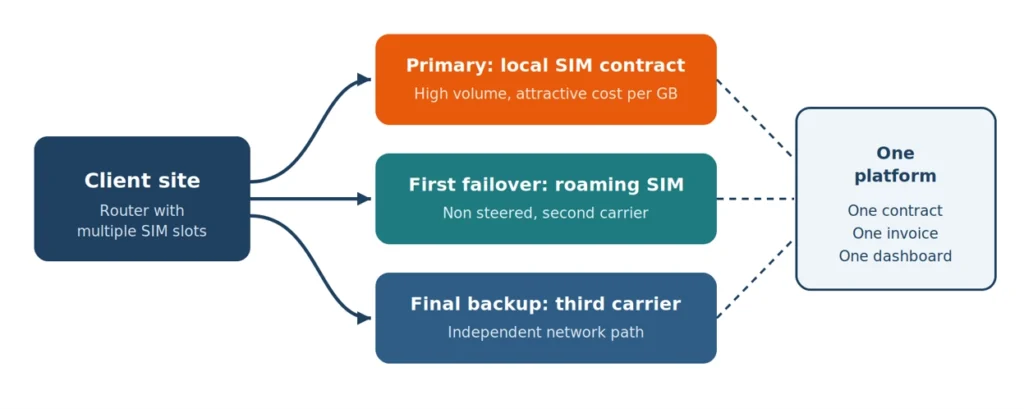
Three independent network paths for one client site, managed from a single platform.
Uptime is one side of performance; upload speed is the other. Most mobile networks are optimised for download, because consumers mainly stream and browse. Business traffic is different.
Video calls, cloud backups, camera feeds and VoIP all send a lot of data upstream. SD-WAN also depends on it, because the controller divides traffic based on the real capacity of each link in both directions.
That is why TNF engineers its connectivity for symmetric speeds, with upload keeping pace with download. With symmetric links, SD-WAN can balance traffic accurately, failover performs as expected when traffic moves to the mobile link, applications behave consistently and bonded connections get full value from every SIM in both directions
For MSPs working with SD-WAN integrators and network architects, this makes mobile links a dependable part of the WAN design.
Security for business critical connectivity
Clients in energy, healthcare, finance and the public sector have strict requirements for how data travels. Mobile connectivity offers several ways to meet them, and it helps to understand what each one does.
A private APN keeps device traffic inside a closed network, separate from the public internet. A fixed IP address gives every device a permanent address, so engineers can reach routers and devices remotely and firewalls can allow only known sources.
The article what is a static or fixed IP address explains when this is useful. An IPsec VPN encrypts traffic between devices and the client’s central systems. IMEI locking ties a SIM to one specific device, so the SIM cannot be used elsewhere if it is removed.
Combined, these options let an MSP offer a secure connectivity package that fits the compliance needs of regulated clients, often as a premium service on top of standard connectivity.
Business models: reselling and white label
MSPs can bring connectivity to market in different ways. In a reseller model, the MSP sells the connectivity partner’s service and adds its own design, installation and support. In a white label model, the MSP offers connectivity under its own brand, sets its own prices and owns the complete client relationship, while the partner runs the networks, SIMs and platform in the background.
White label suits MSPs that see connectivity as a lasting part of their portfolio. Sub accounts give each end client its own view, and wholesale pricing gives the MSP room for a healthy margin.
The white label SIM page and partner reseller services describe both routes, and the benefits of becoming an MVNO reseller gives useful background on the reseller model.
Connectivity needs by sector
Each sector has its own connectivity profile, and knowing these profiles helps an MSP propose the right design from the first conversation.
| Sector | Typical connectivity need | Learn more |
|---|---|---|
| Retail | Reliable branch connectivity for payments and signage, local SIMs for busy stores | MSP for retail |
| Enterprise | SD-WAN underlay, 4G/5G backup and connectivity for travelling teams | MSP in enterprise |
| Transport and logistics | Roaming SIMs that follow vehicles and shipments across borders | MSP in transport |
| Industry | Industrial IoT with private APN and fixed IP for remote access | MSP in industry |
| Energy | Secure connectivity for remote assets such as substations and solar parks | MSP in energy |
| Agriculture | Rural coverage for sensors and connected machinery | MSP in agriculture |
| Maritime | Connectivity for ports, vessels and offshore sites | Maritime MSP |
What is next: 5G and SGP.32
Two developments will shape MSP connectivity in the coming years. The first is the continued rollout of 5G. Besides higher speeds, 5G standalone networks bring lower latency and network slicing, which allows a carrier to reserve capacity for specific business applications. The article on the advantages of 5G explains these features.
The second is SGP.32, the GSMA eSIM standard designed for IoT. It allows devices to download and switch carrier profiles remotely, managed centrally by the organisation that operates the devices.
For MSPs, that means simpler logistics, zero touch provisioning and the flexibility to change carriers over the lifetime of a device without a site visit. SGP.32: the IoT eSIM standard that changes how connected devices are managed covers the standard in detail.
Choosing a connectivity partner
The connectivity partner behind an MSP determines which clients the MSP can serve and how quickly it can grow. When comparing partners, these questions give a clear picture:
- How many carriers are available per country, and in how many countries?
- Can the partner supply roaming SIMs, local SIM contracts, eSIM, FWA hardware and backup together?
- Does one platform cover all SIMs and carriers, with API access and sub accounts for end clients?
- Is pricing transparent, with one invoice and flexible options such as pooled data and per SIM plans?
- Are private APN, fixed IP and VPN available as standard options?
- Is technical support available around the clock, with a clear escalation route?
- Is the partner ready for 5G and SGP.32?
For more guidance, 8 key factors when choosing an M2M roaming partner goes deeper into coverage, pricing and support.
Getting started with managed connectivity
A practical way to start is with one existing client. Map their locations, devices and travelling teams, and note the data use and uptime requirements for each.
That overview shows quickly where FWA, backup links, roaming SIMs or local SIM contracts fit best. A pilot at a few sites then gives both the MSP and the client confidence before rolling out further.
TNF Solutions supports MSPs in this process as a connectivity broker, with access to more than 750 networks, roaming and local SIM contracts, FWA hardware, security services and one management platform. Many MSPs are up and running within days, without a long term commitment.
You can read more on the managed service providers page or talk to a connectivity engineer about your clients’ needs.
Frequently asked questions
What does a managed service provider do in connectivity?
A managed service provider designs, delivers and manages connectivity for its clients as an ongoing service. This can include site broadband through FWA, backup links, IoT SIMs and mobile data for travelling teams, together with monitoring and support, all under one service level agreement.
What is the difference between a steered and a non steered roaming SIM?
A steered roaming SIM connects to the preferred partner network of its home operator in each country. A non steered roaming SIM can select the strongest available network at each location, which improves reliability for backup links and mobile use.
When is a local SIM contract the best choice?
A local SIM contract is the best choice for fixed sites with high data volumes, such as digital signage, surveillance or busy retail locations. It connects directly to a national carrier and offers plans up to 1,000 GB per SIM with fixed low pricing.
Can fixed wireless access be the main connection for a business site?
Yes. With 4G and especially 5G, FWA offers enough capacity to serve as the primary connection for many business sites. It is often used where fibre is unavailable or would take a long time to install, and many MSPs also use it as a backup next to fibre.
Why do symmetric speeds matter for SD-WAN?
SD-WAN divides traffic based on the capacity of each link in both directions. When upload speed matches download speed, the controller can balance traffic accurately and failover performs as expected, which keeps business applications running smoothly.
What is SGP.32 and why does it matter for MSPs?
SGP.32 is the GSMA eSIM standard for IoT devices. It lets devices download and switch carrier profiles remotely, which simplifies logistics and gives MSPs the flexibility to change carriers during a device’s lifetime without a site visit.
Can an MSP offer connectivity under its own brand?
Yes. In a white label model, the MSP offers connectivity under its own brand and sets its own prices, while the connectivity partner runs the networks, SIMs and platform in the background.