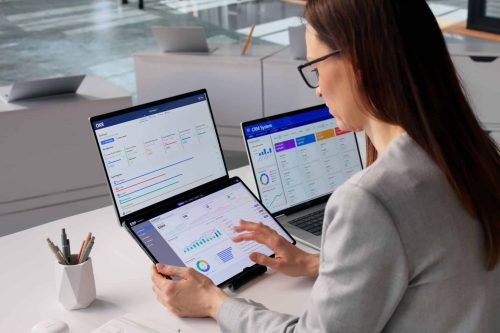

Every connected device starts and ends its life with a SIM. Between those two points sits a process that most businesses only think about when it breaks: SIM card management. For companies running IoT or M2M deployments across multiple countries, that process determines whether connectivity scales smoothly or turns into a daily operational headache.
This guide walks through what SIM card management actually involves, step by step, and where most in house approaches run into trouble. It is written for IT leaders, IoT product owners and managed service providers who need a practical answer to what is sim management and how to do it at scale.
On this page
- What is SIM card management
- Why IoT and M2M need a different approach
- The SIM card management process, step by step
- SIM card management software: what to look for
- Remote SIM management: why it matters at scale
- Why a single carrier SIM is a risk
- How TNF approaches SIM card management
- Frequently asked questions
What is SIM card management
SIM card management is the ongoing process of provisioning, activating, monitoring, controlling and eventually decommissioning the SIM cards or eSIMs that connect devices to a mobile network. For a handful of phones, this is trivial. For a fleet of hundreds or thousands of connected devices, it becomes a full operational discipline with its own tooling, workflows and risks.
In an IoT sim management context, the SIM is embedded infrastructure. It might sit inside a smart meter installed underground for ten years, a vending machine in a country you have never visited, or a fleet tracker on a truck that crosses three borders a week. The SIM has to work without anyone physically touching it, which is exactly why the management layer around it matters more than the SIM itself.
Why IoT and M2M need a different approach
M2M sim management differs from mobile phone contracts in a few structural ways that shape everything downstream:
- Volume over individual value. A single deployment can involve thousands of SIMs, each with a small data footprint, rather than a handful of high usage phone lines.
- No human in the loop. Devices cannot manually reconnect, accept a new APN setting or call support when something goes wrong.
- Long device lifecycles. Industrial and utility deployments often run for five to fifteen years, far longer than a typical consumer contract.
- Cross border deployment. Devices are frequently shipped, installed or moved across countries, which local operator contracts were never designed to handle.
- Business critical uptime. A payment terminal, a security camera or a logistics tracker going offline has a direct commercial cost.
These differences are why a standard operator SIM plan, built for a phone in someone’s pocket, is the wrong tool for an IoT or M2M fleet. It also explains why sim card management shows up as a distinct discipline inside IT and operations teams, rather than something procurement handles once and forgets. For more on how this plays out specifically for machine to machine deployments, see Benefits of global M2M sim cards for IoT without vendor lock in.
The SIM card management process, step by step
Below is the full lifecycle most IoT and M2M deployments move through. Each stage has its own risks, and skipping ahead without solving the previous one is where most in house projects lose control.

Figure: the six stage SIM card management lifecycle. Skipping a step, or managing it manually, is where most in house deployments lose control at scale.
- Selection and sourcing Choosing a SIM type (physical SIM, eSIM or ChipSIM), a coverage model (single carrier, multi network roaming or local in country) and a commercial structure (pooled data, per SIM plans, prepaid or postpaid). This decision made early is the one that most limits or enables everything that follows. For why a managed SIM outperforms a standard operator SIM at this stage, see Managed SIM.
- Provisioning Loading network profiles, credentials and initial configuration onto each SIM before it is deployed, ideally in bulk rather than one device at a time.
- Activation Turning the SIM on at the point of installation, whether that is a warehouse, a field technician’s van or a customer’s site. Zero touch activation, where the SIM connects automatically the first time the device powers on, removes the single biggest source of deployment delay. This is the model behind SGP.32, the GSMA standard for remote SIM provisioning built specifically for IoT; see SGP.32: the IoT eSIM standard that changes how connected devices are managed for how it works.
- Monitoring and alerting Tracking usage, connectivity status and network performance in real time, with automated alerts for anomalies such as unexpected data spikes, SIMs that have gone offline, or usage nearing a plan limit.
- Optimisation Adjusting data plans, carrier selection or security policies as usage patterns become clear. A device that consumes far less data than provisioned is an easy cost saving; one that consumes far more is an early warning sign.
- Decommissioning Suspending or terminating SIMs when a device is retired, replaced or decommissioned, and reallocating that capacity rather than letting it sit on an invoice indefinitely.
For a deeper look at the back half of this process, including how to handle suspension, replacement and secure decommissioning at scale, see SIM lifecycle management: from provisioning to decommissioning.
SIM card management software: what to look for
Manual SIM card management, spreadsheets, carrier portals logged into one at a time, does not survive contact with more than a few hundred SIMs. This is where sim card management software, more commonly called a connectivity management platform (CMP), takes over.
A capable CMP should give you:
- A single dashboard for every SIM, regardless of which network it sits on
- Bulk provisioning and activation, instead of one by one manual setup
- Real time usage data and configurable alerting rules
- API access so SIM management can be built into your own systems rather than run as a separate manual task
- Policy controls such as data caps, geofencing and automatic suspension
- Consolidated billing across carriers, countries and SIM types
If your evaluation criteria stop at “does it show me a list of SIMs,” you are buying a monitoring tool instead of a management platform. TNF’s own connectivity management platform is built around this distinction, combining CMP functions with eSIM orchestration in one interface.
For how this compares to a standard carrier portal, see IoT CMP vs carrier portal: what’s the difference for resellers and MSPs, and for the platform basics, connectivity management platform (CMP): most frequently asked questions.
For a full breakdown of platform requirements at MSP scale, read SIM management platforms: what MSPs need for scalable IoT.
Remote SIM management: why it matters at scale
Remote sim management is what turns SIM management from a reactive task into a controlled operation. Instead of physically accessing a device or calling a carrier’s support line, a remote platform lets you:
- Suspend or reactivate a SIM instantly if a device is lost, stolen or compromised
- Push configuration changes, such as APN settings or data limits, without a site visit
- Diagnose a connectivity failure from a dashboard before dispatching a technician
- Swap a device between carriers or networks without changing the physical SIM
This matters most for devices that are difficult, expensive or impossible to reach in person. A smart meter cemented into a utility cabinet or a tracker on a shipping container is not getting a return visit for a configuration change.
Remote control is the only viable operating model. It is also a security control, not just an operational one; see how M2M SIMs help with minimalizing IoT vulnerabilities for what can go wrong without it.
Why a single carrier SIM is a risk
A common mistake in early stage IoT deployments is treating SIM card management as a procurement decision: pick one carrier, buy a bulk plan, done. This works until a device crosses a border the carrier does not cover well, a network has a regional outage, or usage patterns change and the plan no longer fits.
This is precisely why TNF acts as a connectivity broker across more than 750 networks in 200+ countries, working through white label multi carrier SIMs rather than a single house network, which means the right answer for a given deployment is rarely “one carrier.” It might be a multi network SIM with automatic failover for a fleet that moves across regions. It might be a fixed local SIM contract for a site with high, predictable data volumes where local carrier rates beat roaming pricing outright. It is often a hybrid of both, managed from the same platform, on the same invoice.
That broker position is the difference between being sold a product and being given the option that actually fits the deployment.
How TNF approaches SIM card management
TNF is a connectivity broker with wholesale access to multi carrier coverage, local SIM contracts, and the CMP tooling to manage all of it from a single platform. In practice, that means:
- Multi carrier IoT SIMs with automatic failover between 3 to 5 networks per country, so a single carrier outage never becomes a device outage, with 4G/5G backup available as a standalone product for fixed sites
- Local SIM contracts for fixed, high volume sites, where national carrier rates make more commercial sense than roaming, running from hundreds of gigabytes up to 1,000 GB per SIM
- One connectivity management platform covering provisioning, activation, monitoring, alerting and decommissioning across every SIM type and network
- Private APN, fixed IP and IPsec VPN options for deployments with compliance or security requirements, including static and fixed IP addresses where devices need consistent, secure remote access
- One consolidated invoice, regardless of how many carriers or countries a fleet touches
If you are evaluating how this fits into a broader managed service offering, our managed service provider page outlines how partners package this into a resellable connectivity product.
Ready to see what a multi carrier SIM management setup looks like for your deployment? Talk to a connectivity engineer to walk through it.
FAQ
What is SIM management?
SIM management is the process of provisioning, activating, monitoring, controlling and decommissioning SIM cards or eSIMs across their operational life. For businesses, it usually refers to managing this process across many devices at once rather than a single SIM.
What is IoT SIM management specifically?
IoT sim management applies the same lifecycle to SIMs embedded in connected devices such as sensors, meters, trackers and terminals, where devices cannot be manually reconfigured and often stay in the field for years.
How is M2M SIM management different from a normal mobile plan?
M2M sim management deals with large volumes of low usage SIMs, cross border deployment and long device lifecycles, none of which a standard consumer mobile contract is built to handle.
What does SIM card management software actually do?
Sim card management software, or a connectivity management platform, gives a single dashboard for provisioning, monitoring, alerting and billing across every SIM in a fleet, regardless of carrier or country.
Can SIMs be managed remotely without physical access to the device?
Yes. Remote sim management allows suspension, reactivation, configuration changes and diagnostics to be carried out from a platform, without a technician visiting the device.
Does TNF only offer roaming SIMs?
No. TNF supplies both multi carrier roaming SIMs and local SIM contracts, managed from the same platform, so fixed high volume sites and mobile fleets can be handled under one commercial agreement.