Managed service providers increasingly deliver connectivity alongside their IT, network and security services. Clients open branches abroad, roll out IoT devices across several countries and expect every location to be online from day one. Managed connectivity solutions make this possible by bringing networks, SIMs, hardware, monitoring and support together in one service.
This article explains how managed connectivity solutions work, how global IoT connectivity functions technically, which pricing models suit MSPs and which questions help you evaluate a global partner.
What are managed connectivity solutions?
Managed connectivity solutions are services in which one partner delivers and manages the connectivity for a company’s sites, devices and users. The partner arranges network access with mobile operators, supplies SIMs or eSIMs, provides monitoring and support, and consolidates billing. The MSP delivers this as part of its own service portfolio, often under its own brand.
A complete managed connectivity solution usually consists of six building blocks:
- Network access through agreements with mobile network operators in each country.
- SIM and eSIM supply, ranging from global roaming SIMs to local SIM contracts.
- Hardware, such as cellular routers and fixed wireless access (FWA) equipment.
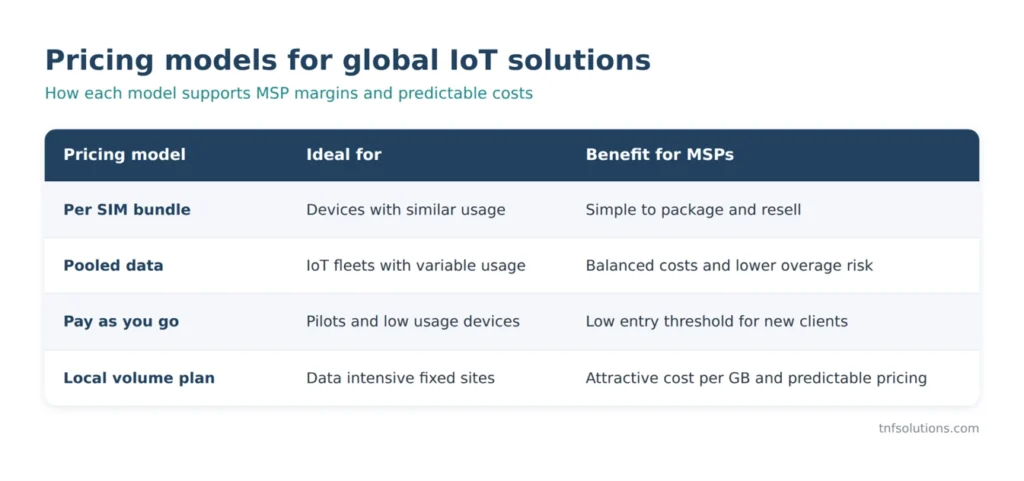
- A connectivity management platform for monitoring, control and automation.
- Security services such as private APN, fixed IP and VPN.
- Support and billing, with a defined SLA and consolidated invoicing.
For MSPs, managed connectivity turns connectivity into a recurring revenue line that strengthens existing client relationships. It also fits naturally with services MSPs already deliver, such as SD-WAN, branch networking and IoT management. If fixed wireless access is new to you, our article on what fixed wireless access is, is a good starting point.
How global IoT connectivity works
Global IoT connectivity allows devices to connect in many countries using a single SIM or eSIM profile. Several technologies make this possible.
Roaming agreements. A SIM is issued by a home operator or MVNO that holds roaming agreements with operators in other countries. When a device travels or is installed abroad, it connects to a partner network through these agreements. The more agreements a provider has, the wider the coverage and the more networks are available per country.
Multi network access per country. Global IoT SIMs often have access to several networks in the same country. This enables the device to connect to the network with the best signal at its location and to switch to another network when needed.
Steered and non steered roaming. With steered roaming, the home operator directs the device towards preferred partner networks. Non steered SIMs let the device select the strongest available network. Non steered roaming is especially valuable for business critical deployments where signal quality matters most.
Multi IMSI. An IMSI is the identity a SIM presents to a network. Multi IMSI SIMs carry several identities and can switch between them, allowing a device to appear as a local subscriber in certain markets. This improves coverage options and can support compliance with local rules.
eSIM and remote provisioning. eSIM technology (eUICC) allows operator profiles to be downloaded and changed over the air. For IoT, the GSMA SGP.32 standard makes remote profile management simpler and more scalable, which is ideal for large rollouts and devices with long lifecycles.
Our article on SGP.32, the IoT eSIM standard explains this in detail.
Together, these technologies give MSPs a flexible foundation: one SIM strategy that can serve clients in dozens of countries.
Permanent roaming and the role of local SIM contracts
Roaming SIMs are designed for devices that move or that operate in many countries. When a device stays in one foreign country permanently, the situation is called permanent roaming.
Some countries, including Brazil, Turkey and India, have regulations that restrict permanent roaming or require devices to be registered locally. Operators in other markets may also set commercial limits on long term roaming.
For fixed sites with high data usage, cost is a second consideration. Roaming traffic travels through international agreements, which is priced for flexibility. Local SIMs connect directly to a national carrier’s infrastructure and are priced for volume.
For a site using hundreds of gigabytes per month, a local contract often makes the business case work.
Local SIM contracts are a strong fit for:
- Digital signage networks with many screens.
- Video surveillance that streams continuously.
- Retail locations that process transactions all day.
- Logistics hubs and warehouses with constant data traffic.
- Long term deployments in countries with permanent roaming rules.
The most effective approach for many clients is a hybrid model. Fixed, high volume sites run on local SIMs, while travelling staff, vehicles and IoT devices across borders use global roaming SIMs.
When both are managed from the same platform and contract, the client enjoys cost efficiency at fixed sites and flexibility everywhere else.
TNF offers both options as a connectivity broker. Alongside global multi network SIMs, TNF supplies local SIM contracts with plans from hundreds of gigabytes up to 1,000 GB per SIM, combined in one account and one invoice.
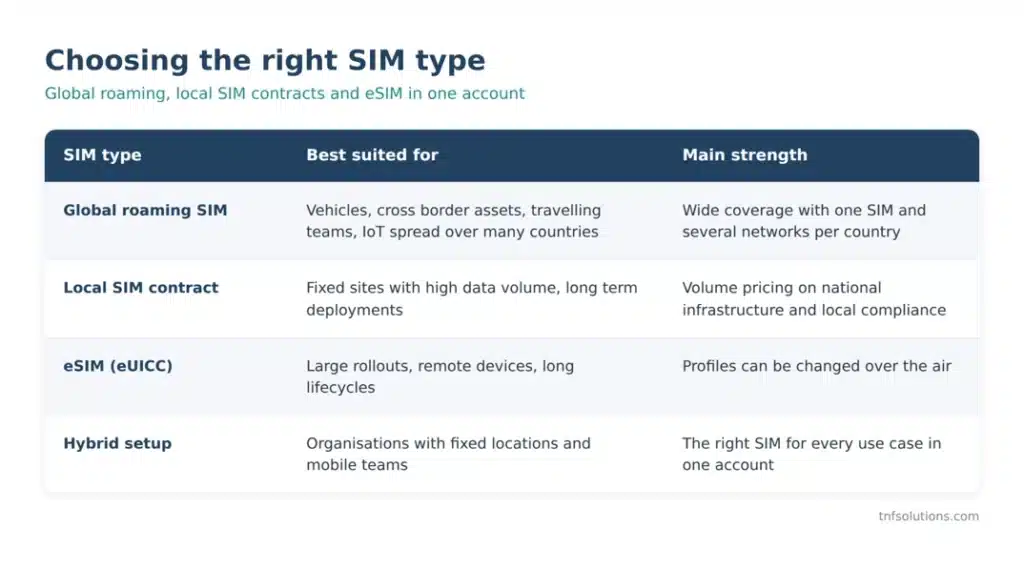
Pricing models for global IoT solutions
The pricing model has a direct effect on an MSP’s margin and on how predictable costs are for the end client. These are the most common models.
Per SIM bundles. Each SIM receives a fixed monthly data allowance. This is easy to understand and to resell, and it works well when every device uses a similar amount of data.
Pooled data. A group of SIMs shares one data pool. Devices that use more are balanced by devices that use less, which reduces the risk of overage and makes pooling attractive for IoT fleets with variable usage.
Pay as you go. The client pays for actual usage. This suits pilots, seasonal deployments and devices with very low or unpredictable traffic.
Local volume plans. High volume plans on local SIM contracts, with a fixed price for an agreed volume. These are ideal for data intensive fixed sites.
Prepaid and postpaid. Prepaid models give full cost control in advance, while postpaid models offer flexibility and monthly invoicing.
For MSPs, the key questions are how easily a model can be packaged for clients, how usage can be allocated per client, site or cost centre, and how alerts and limits help prevent unexpected costs. Transparent wholesale pricing makes it straightforward to set your own margin.
Building resilience into global cellular IoT connectivity
For business critical sites, the value of global cellular IoT connectivity lies in how reliably it keeps clients online. Three design principles help achieve this.
Automatic multi network failover. When a SIM can access several networks, the connection can move to another network during an outage or congestion. Good platforms monitor latency, packet loss and throughput and switch within seconds.
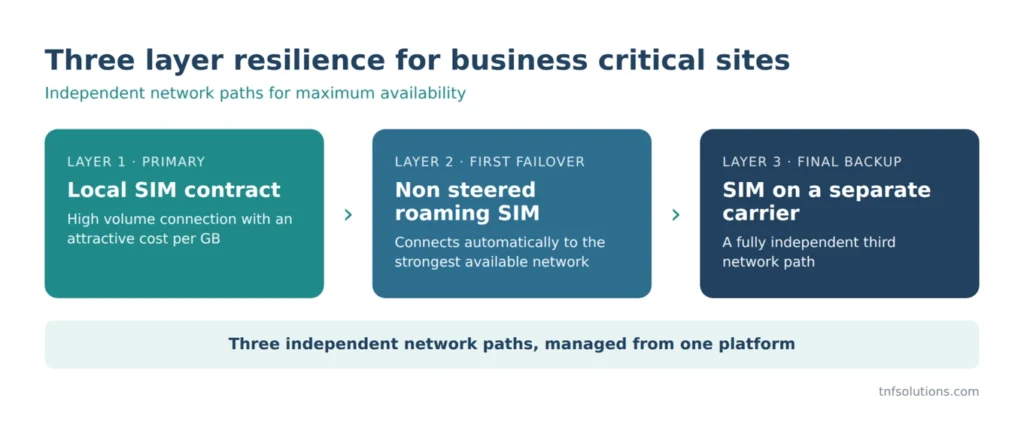
Layered backup architectures. Multiple SIMs on separate carriers create independent network paths. A proven setup combines a local SIM as primary connection for volume and cost, a non steered roaming SIM as first failover and a SIM on a separate carrier as final backup. This gives payment terminals, display networks and logistics hubs a very high level of availability. Dual SIM or multi modem routers make this practical at each site.
Symmetric performance. Many mobile networks are optimised for download traffic. Business applications also depend on upload capacity, especially SD-WAN, VoIP, video surveillance and cloud applications. Symmetric connectivity, with upload speeds that match download speeds, supports accurate load balancing, reliable failover and predictable SLA delivery. This makes a cellular link a full SD-WAN underlay.
Read more about combining cellular links with SD-WAN and about 4G/5G backup and failover in practice.
These principles apply to branch networks as well. Our article on branch connectivity solutions for distributed offices shows how to design reliable WAN connectivity across many locations, and 5G fixed wireless access market trends explores how 5G expands these options.
The role of a connectivity management platform
A connectivity management platform (CMP) is the central tool for managing every SIM and connection, regardless of which network carries the traffic. For MSPs managing many clients and countries, it is the foundation for efficient operations.
Important capabilities include:
- Real time monitoring of connection status, data usage and network performance.
- Alerts and automated rules for usage thresholds, connection drops and unusual behaviour.
- SIM lifecycle management, from activation and plan changes to suspension and decommissioning.
- Multi tenant structures so each end client has its own account or sub account.
- API access with consistent data across all networks, for integration into the MSP’s own portal, ticketing or billing systems.
- Reporting per client, site or cost centre for clear cost allocation.
With one platform for all connections, engineers diagnose issues faster and clients receive answers sooner.
Our article on connectivity management platforms as the MSP’s control tower goes deeper into platform features. For the SIM side, read SIM management platforms: what MSPs need for scalable IoT and our article to SIM lifecycle management.
Security requirements for enterprise deployments
Enterprise clients and regulated sectors such as energy, healthcare, finance and public services set clear security requirements for connectivity. These features are the most relevant:
- Private APN. Device traffic runs through a private network environment, separated from the public internet.
- Fixed IP addresses. Public or private fixed IPs allow secure remote access to routers, cameras and IoT devices. Our article on static or fixed IP addresses explains when you need one.
- IPsec VPN. Encrypted tunnels connect devices securely to central systems or cloud environments. See IPsec VPN for IoT.
- IMEI lock. A SIM only works in the device it is assigned to, which protects against misuse.
- Policy control. Rules for traffic, destinations and usage per SIM or group.
For MSPs, security features also create an opportunity to offer premium connectivity packages for regulated verticals, with compliance ready infrastructure as a clear added value.
SLA metrics worth checking
An SLA defines what clients can expect and what the MSP can promise in turn. When reviewing a connectivity partner’s SLA, these metrics give the clearest picture:
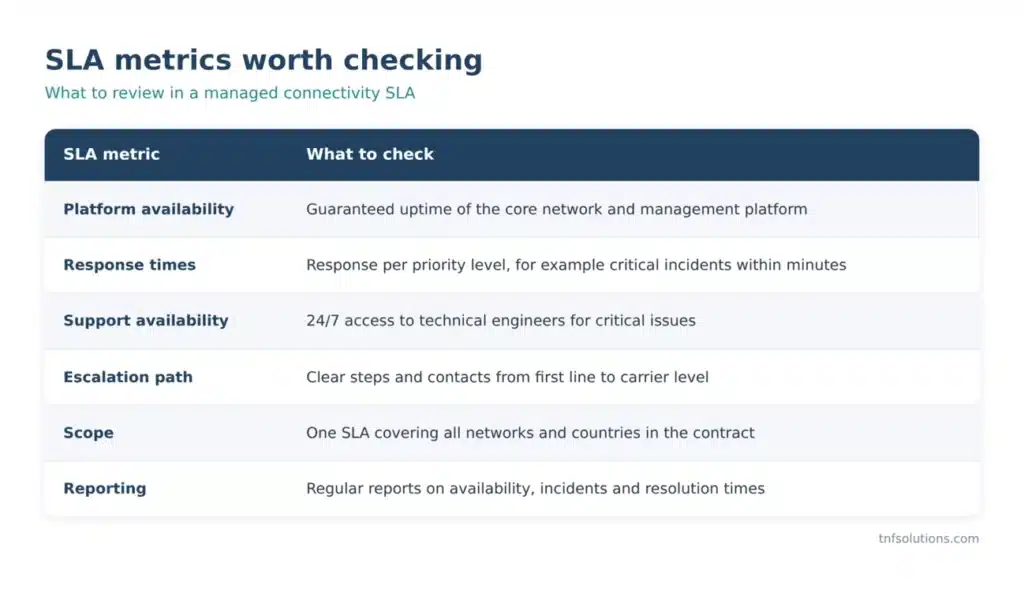
A single SLA across all networks makes it much easier for an MSP to offer its own clients a consistent service level in every market.
Questions to ask a global IoT solutions provider
Use these questions when evaluating an IoT connectivity service provider. They help you compare partners on the points that matter most for MSPs.
Coverage and networks
- How many networks are available in the countries where my clients operate?
- Are SIMs steered or non steered, and can I choose per use case?
- Which options are available for countries with permanent roaming rules?
SIM and eSIM options
- Do you offer both global roaming SIMs and local SIM contracts?
- Are your eSIM solutions ready for SGP.32?
- Which SIM form factors are available for industrial devices?
Platform and integration
- Can I manage all SIMs, networks and clients from one platform?
- Is there a well documented API?
- Can I create sub accounts per end client?
Commercial model
- Which pricing models are available, such as pooled, per SIM and local volume plans?
- Can I sell the service under my own brand and set my own margin?
- How are usage and costs reported per client?
Security and support
- Are private APN, fixed IP, IPsec VPN and IMEI lock available?
- Is technical support available 24/7, and what does the escalation path look like?
- Is there one SLA for all networks and countries?
Hardware and flexibility
- Can you supply and configure routers for FWA and backup scenarios?
- How quickly can a new country or site be added?
For more selection criteria, see 8 key factors when choosing an M2M roaming partner.
How TNF supports MSPs as a connectivity broker
TNF works as a connectivity broker for MSPs. With access to 750+ networks in 200+ countries, TNF selects the combination of carriers, SIM types and hardware that suits each client situation.
The portfolio includes global multi network SIMs, local SIM contracts for high volume sites, eSIM, fixed wireless access and backup solutions with hardware from vendors such as Teltonika, Cisco and Cradlepoint, and security services including private APN, fixed IP and IPsec VPN.
Everything is managed from one connectivity management platform, covered by one SLA and billed on one consolidated invoice. MSPs can offer the service under their own brand and set their own margins. Discover what this looks like for your business on our page for managed service providers.
Frequently asked questions
What are managed connectivity solutions?
Managed connectivity solutions are services in which one partner delivers and manages network access, SIMs, hardware, monitoring, support and billing for a company’s connections. MSPs use them to offer connectivity as part of their service portfolio.
What is global IoT connectivity?
Global IoT connectivity allows devices to connect in many countries with one SIM or eSIM profile, using roaming agreements, multi network access per country, multi IMSI technology and remote eSIM provisioning.
What is the difference between a global roaming SIM and a local SIM contract?
A global roaming SIM connects through international roaming agreements and suits devices that move or operate in many countries. A local SIM contract connects directly to a national carrier and suits fixed sites with high data usage or long term deployments in one country. Both can be combined in a hybrid setup.
What is permanent roaming?
Permanent roaming means a roaming SIM is used long term in one foreign country. Some countries, such as Brazil, Turkey and India, have regulations for this situation. Local SIM contracts or multi IMSI solutions are common ways to support deployments in these markets.
Which pricing model is best for IoT fleets?
Pooled data is often the best fit for fleets with varying usage, because devices share one data pool. Per SIM bundles suit devices with similar usage, and local volume plans suit data intensive fixed sites.
What should an SLA for managed connectivity include?
A strong SLA covers platform availability, response times per priority level, 24/7 support for critical issues, a clear escalation path and one scope covering all networks and countries.