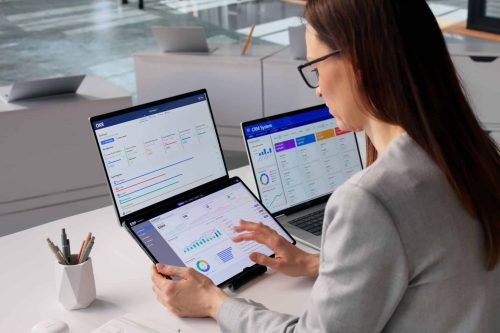

A device sitting in a cabinet 4,000 kilometres away can be monitored, configured and fixed entirely from a screen, without a technician or a local SIM card on site. That is the standard remote SIM management makes possible, replacing the older model of one carrier portal per country, manual configuration per SIM, and a support ticket that waits for someone to physically reach the device.
Remote SIM management removes the site visit from the equation entirely. For MSPs running IoT and M2M fleets across multiple countries and carriers, it is the capability that turns a growing SIM base from an operational risk into a manageable, billable service line.
Table of contents
- What is remote SIM management
- Why remote control matters once a fleet gets large
- What MSPs can actually do remotely
- Roaming SIM data management
- SIM inventory and asset management
- One platform, many carriers: the broker advantage
- How remote SIM management protects MSP margin
- How TNF supports remote SIM management for MSPs
- FAQ
What is remote SIM management
Remote SIM management is the ability to monitor, configure, suspend, reactivate and troubleshoot a SIM or eSIM from a software platform, without physically accessing the device or the SIM itself.
That includes checking live status and data usage, changing a rate plan or data cap, locking a SIM to a specific device (IMEI lock), pushing a carrier profile change, and shutting a SIM down the moment a device is lost, stolen or decommissioned.
For IoT SIM management specifically, remote control is a core operational requirement. Most connected devices, meters, trackers, routers, sensors, sit in places nobody visits regularly: a utility cabinet, a shipping container, a vehicle, a remote industrial site.
A managed IoT SIM needs to be fully manageable from a screen, so every device stays connected and in control regardless of where it is deployed.
Why remote control matters once a fleet gets large
A handful of SIMs can be managed by memory and a spreadsheet. A dedicated platform becomes the practical requirement well before a fleet reaches a few hundred connections, and it becomes essential once an MSP is running SIM management for large IoT networks spanning multiple countries and multiple underlying carriers.
At scale, three problems appear at the same time:
Visibility. A single dashboard brings usage data from every carrier into one place, with one login and one reporting format, so a spike in usage on any carrier gets caught quickly.
Inconsistent control. Suspending a SIM, changing a data cap or locking a device to a specific IMEI works differently depending on which carrier issued the SIM, and some carriers offer a more limited set of controls than others. Delivering one standard of service to a client depends on having standardised tooling underneath it.
Manual response time. When something goes wrong, whether a device goes dark, a SIM is used outside its expected footprint, or a bill spikes unexpectedly, the time to detect and respond depends entirely on how many portals someone has to check manually. That delay is where cost and client trust are lost.
Remote SIM management, delivered through a single connectivity management platform, is what removes all three problems at once. This is the same reasoning behind why an MSP needs a proper platform in the first place, covered in SIM management platforms: what MSPs need for scalable IoT.
What MSPs can actually do remotely
In practice, remote SIM management covers a specific, repeatable set of actions:
- Live status and usage monitoring, per SIM, per device, per client, in near real time
- Activation and deactivation, so a new device can be brought online, or an old one shut down, without waiting for a carrier
- Usage alerts and thresholds, so an MSP is notified as soon as usage approaches a limit, ahead of any bill spike
- Rate plan and data cap changes, applied instantly, directly from the platform
- IMEI locking, tying a SIM to one specific device to prevent unauthorised use if it is removed
- Remote suspension, for a lost, stolen or compromised device, cutting off connectivity immediately
- OTA profile and carrier switching, moving a SIM or eSIM to a different underlying network without a physical swap
- Diagnostic tools, to check signal, network attach status and connection history when a client reports a problem
Individually, each of these capabilities is familiar. Bringing all of them together on one consistent platform, for every SIM, regardless of which underlying network it runs on, is what genuinely changes the equation for SIM management for large IoT networks.
SIM inventory and asset management
SIM inventory management and SIM asset management are the parts of remote SIM management that deserve real attention, since consistent upkeep here protects margin directly. Active inventory maintenance is what prevents orphan SIMs, connections still active, and still billed, for devices that were retired, replaced or lost months ago, from ever accumulating.
A proper remote platform ties inventory directly to actual device state, giving an MSP a live, accurate picture of every SIM by client, by site, by device type and by status. Any SIM that goes inactive for longer than expected can trigger an automatic review, keeping the fleet accounted for and every SIM properly reflected on the invoice.
This is the same discipline covered in more depth in SIM lifecycle management: from provisioning to decommissioning, which walks through the full path from first provisioning to final shutdown.
One platform, many carriers: the broker advantage
Many connectivity partners sell one thing: a SIM, from one carrier, that works everywhere through roaming. That model suits light, occasional use well, and fixed sites running dozens of connected devices continuously, or clients who need guaranteed performance in a specific country, benefit from a broader set of options.
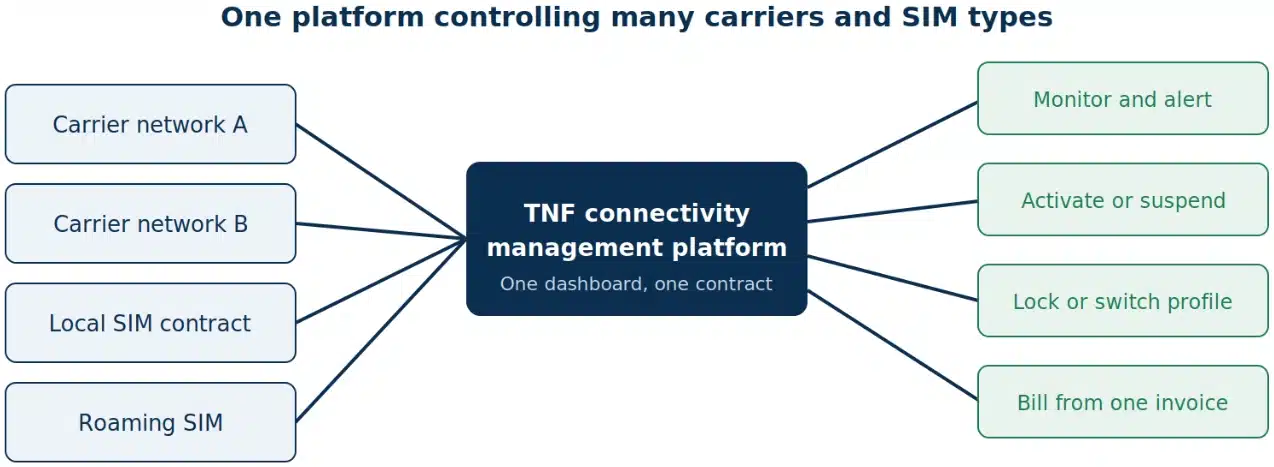
TNF operates as a broker across hundreds of mobile networks worldwide, offering two distinct SIM types from the same platform and the same contract:
| Global roaming SIM | Local SIM contract | |
|---|---|---|
| Best for | Mobile assets, cross border devices, occasional use | Fixed, high volume sites: digital signage, surveillance, retail |
| Pricing | Priced for flexibility across countries | Priced at national carrier rates for volume |
| Typical use | Vehicles, field devices, travelling equipment | Data heavy fixed installations |
| Managed from | Same CMP, same contract | Same CMP, same contract |
The two can run side by side on a single site, with a local SIM handling primary connectivity and a roaming SIM acting as automatic failover on a different carrier, all monitored, controlled and billed from one place.
That combination, more network options and remote control over all of them at once, is the actual broker advantage. It is what makes it possible for an MSP to answer “what if we need something different for this client” without switching connectivity partners.
This broker model is described in more detail on the IoT Mobile partner and reseller connectivity page, and it is the same underlying idea behind TNF’s managed service providers page: one partner, many networks, one platform.
How remote SIM management protects MSP margin
Remote SIM management protects margin in ways that add up quickly across a large fleet: a roaming spike gets caught and contained before it can meaningfully inflate a bill, a single dashboard resolves a support ticket in minutes instead of days, an inventory review catches an orphan SIM before it runs up months of unnecessary billing, and a client sees a live dashboard that reinforces their confidence in the partnership.
Across a fleet running into the thousands of connections, these gains add up to a meaningful, proactively protected share of an MSP’s margin.
How TNF supports remote SIM management for MSPs
TNF’s connectivity management platform gives MSPs a single dashboard covering activation, monitoring, alerting, IMEI locking, remote suspension and OTA profile switching, across every SIM in the fleet, whether it is a global roaming SIM or a local SIM contract, and regardless of which of TNF’s hundreds of underlying carrier relationships it runs on.
That platform is described in full on TNF’s IoT Connectivity Management Platform and eSIM Orchestration page, and the white label SIM options behind it are covered on the white label IoT SIM cards page. For clients with regulated or security sensitive deployments, remote SIM management pairs directly with private APN and IPsec VPN for IoT, so control and security are delivered together, on the same platform.
MSPs comparing what a real connectivity management platform should offer against a basic carrier portal can also see the direct comparison in IoT CMP vs. carrier portal: what’s the difference for resellers and MSPs?. For MSPs weighing up whether to build this capability in house or take it from a partner, becoming an IoT partner or reseller lays out how the white label model works in practice, and it connects into the wider control layer covered in [connectivity management platforms: the MSP’s control tower].
If a client’s IoT fleet is growing past the point where a spreadsheet and a couple of carrier logins can keep up, TNF’s connectivity engineers can walk through what remote SIM management for that specific fleet size and mix of countries should look like, on our managed service providers page.
FAQ
What is remote SIM management? Remote SIM management is the ability to monitor usage, activate or suspend a SIM, change its rate plan, lock it to a device, or switch its carrier profile, all from a software platform, without needing physical access to the SIM or the device it serves.
How is remote SIM management different from a carrier’s own portal? A single carrier’s portal shows and controls the SIMs issued by that carrier. A (branded) connectivity management platform extends that same visibility and control to every SIM in a fleet, across every underlying carrier, from one login and one set of tools.
What is managed IoT SIM management, in practice? It means an MSP or connectivity partner actively provisions, monitors, secures and bills SIMs on the client’s behalf, taking full ownership of usage and lifecycle throughout the connection.
Can roaming SIM data usage really be tracked in near real time? Yes, on a proper platform. Usage data from the underlying network is reported back through the platform continuously, which is what makes usage alerts and automatic caps possible well ahead of the invoice.
Why does SIM inventory management matter if the SIMs are already working? Because a SIM that is working but no longer attached to an active device is still being billed. Inventory management is what surfaces those orphan SIMs before they accumulate into a real cost over months or years.
Does TNF only supply roaming SIMs for remote management? TNF supplies both global roaming SIMs and local SIM contracts for fixed, high volume sites, managed and remotely controlled from the same platform and the same contract, giving an MSP the flexibility to match the right SIM type to each use case.